
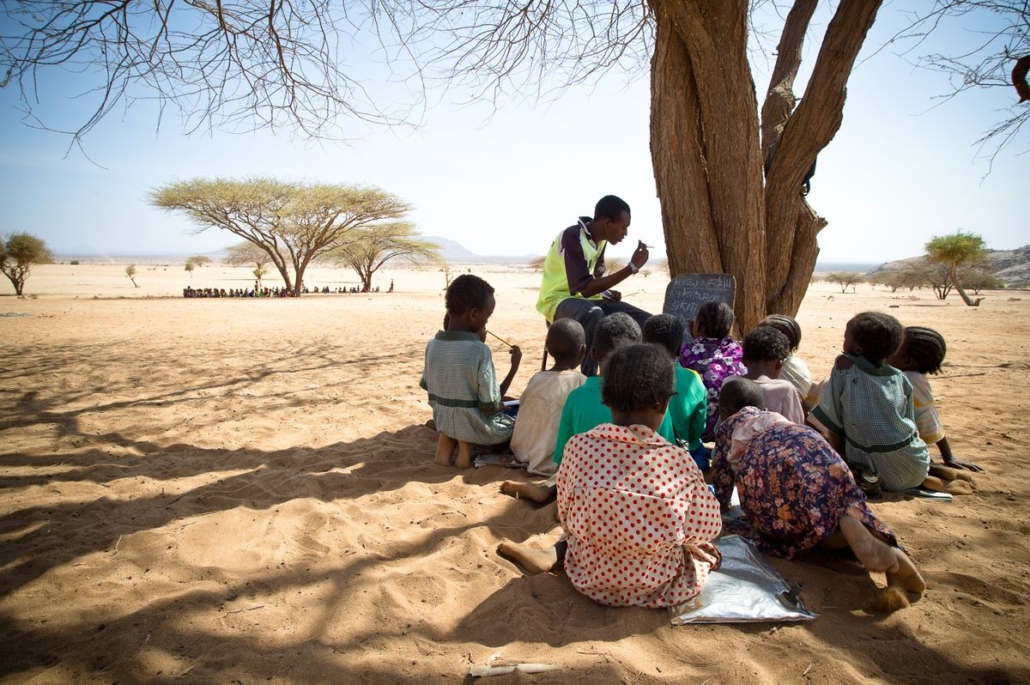
Informal but essential: Why Africa’s low-cost schools deserve better policy
Informal schools are educating millions. Ignoring them won’t make them disappear; regulating them might make them better.
Walk down the backstreets of Nairobi’s Kibera or the outskirts of Lagos, and you’re more likely to stumble across a makeshift school than a public one. Corrugated iron walls, plastic chairs, chalk on blackboard. These are not state-sanctioned classrooms, but for millions of African children, they are the only ones that exist.
Informal schools are not new. But their persistence, and in many places, quiet expansion, tells a deeper story. They are less a rebellion against formal education systems than a response to their failure. In neighbourhoods where public schools are overcrowded, underfunded or simply absent, informal providers have stepped in, not always with excellence, but often with intent.
Governments, for their part, have looked the other way. Education ministries have long treated these schools as temporary nuisances, tolerating irregularities that are too politically sensitive to shut down, yet too unregulated to formally support. That silence is no longer sustainable. Informal schools are not disappearing. They are proliferating. And their role in the future of African education, particularly for the urban poor, is far too large to ignore.
At Havilah Strategies, we believe that the real policy challenge is not how to eradicate these schools, but how to engage them and bring informal education into the fold without bureaucratising it into oblivion. That begins with recognising one simple truth: in many places, informal schools are not second-best. They are the only option.
A system outside the system
Informal schools in Africa exist not because parents reject the formal education system, but because the formal system rejected them first. In overcrowded cities and neglected peri-urban settlements, public schools often struggle to accommodate the sheer volume of school-age children. Where they do exist, infrastructure is weak, teacher absenteeism is high, and learning outcomes are dismal. In response, low-cost private providers, sometimes religious institutions, sometimes enterprising individuals, have filled the vacuum. Their existence is not ideological. It is functional.
The appeal is straightforward. Informal schools are usually close to home, charge modest fees, and offer more predictable access to teachers and materials than many public alternatives. In Kenya, Nigeria, Uganda and elsewhere, studies have shown that parents, especially those in low-income urban areas, often choose informal providers not out of preference, but out of necessity. For them, proximity, safety, and consistency matter more than whether the building meets zoning codes or the curriculum has ministry approval.
And yet, these schools operate in a precarious legal limbo. Most are unregistered. Their teachers are unlicensed. Their materials are unregulated. Some charge exploitative fees. Many deliver instruction of dubious quality. There is, to be clear, no shortage of concerns. But these concerns are not resolved by pretending these schools don’t exist. Nor are they helped by blanket crackdowns that shutter classrooms without offering alternatives.
Governments have tended to alternate between neglect and hostility. In some cases, authorities have attempted to close informal schools outright, citing health, safety, or licensing violations—often without addressing the root causes that created the demand in the first place. In other cases, informal providers are tolerated but excluded from national policy frameworks, teacher training, or subsidy schemes.
This regulatory schizophrenia, neither full recognition nor full rejection, hurts everyone. Parents are left without recourse. Teachers operate without support. Students learn in the shadows of a system that refuses to acknowledge them. And policymakers, by maintaining the illusion of a binary, formal or nothing, miss the chance to build something better.
A Better Way to Recognise What Already Exists
At Havilah Strategies, we do not romanticise informal schools. However, we also cannot ignore what they reveal: that the demand for education has long outpaced the state’s ability to provide it. Informal providers, for all their flaws, have helped carry the burden quietly, flexibly, and often with minimal support. The policy question is no longer whether to legitimise them. It is about how to integrate them, without collapsing their flexibility or compromising on quality.
That begins with data. Most governments lack even a basic registry of unapproved schools, let alone performance metrics or student outcomes. A national mapping exercise, one that includes community-based and faith-run providers, would be a start. You cannot improve what you refuse to count.
Next comes engagement. Informal school operators, while often wary of state interference, also express a need for training, access to curriculum materials, and recognition. Rather than imposing uniformity, governments should offer tiered accreditation systems and invite these schools to participate in public-private dialogue. Quality standards can be upheld without insisting on carbon-copy structures.
Finally, financing needs to reflect the ecosystem as it is, not as it appears on official records. Targeted subsidies, voucher schemes, or results-based grants can bring informal schools into policy frameworks, provided they are tied to minimum safeguards on learning, access, and governance.
In short: stop fighting the wrong battle. Informal schools are not a problem to eliminate. They are a system to improve. With the right regulatory imagination, they can become a critical part of expanding education access in some of Africa’s fastest-growing and most underserved communities. Policy should not punish reality. It should build with it.
References
- Crawfurd, L. et al. (2020). The Global Learning Crisis: Education Quality and Attainment in Developing Countries. Center for Global Development.
https://www.cgdev.org - UNESCO. (2023). Education for All Global Monitoring Report – Sub-Saharan Africa Regional Review.
https://www.unesco.org - World Bank. (2021). The Role of Low-Cost Private Schools in Developing Countries.
https://openknowledge.worldbank.org - African Population and Health Research Center (APHRC). (2013). Quality and Access in Private Schools: Nairobi Informal Settlements.
https://aphrc.org - Bold, T. et al. (2017). What Do Teachers Know and Do? Evidence from Primary Schools in Africa. World Bank Policy Research Working Paper.
https://documents.worldbank.org - Uwezo Africa Initiative. (2022). Are Our Children Learning? A Status Report on Education in East Africa.
https://uwezo.net - Oketch, M. et al. (2010). Public–Private Partnerships in Education: A Review of the Evidence. Department for International Development (DFID).
https://assets.publishing.service.gov.uk - Global Schools Forum. (2021). Unlocking the Potential of Non-State Education in Africa.
https://globalschoolsforum.org - Human Rights Watch. (2015). “Who Will Educate Me?” Barriers to Education for Children in Kenya’s Informal Settlements.
https://www.hrw.org - Oduro, G. et al. (2019). Mapping Private Education Providers in Ghana: Insights from Accra and Kumasi. Education Sub Saharan Africa (ESSA).
https://essa-africa.org



Leave a Reply
Want to join the discussion?Feel free to contribute!